Detailed Description
What Is Composite Flat Cable?
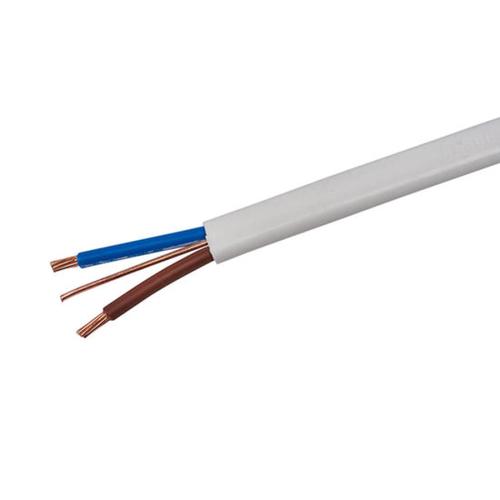
A composite flat cable combines power conductors and signal/control cores in a parallel layout within a flat PVC or PUR jacket — one cable that carries all the electrical functions for a moving machine or equipment in a space-efficient, anti-torsion flat profile. The flat geometry is the defining feature: it prevents the cable from twisting (a twisted pendant or festoon cable is difficult for the operator or the cable management system to control), allows tighter bending in the flat plane, and stacks neatly in festoon trolley loops or cable carrier systems.
The composite designation means that power and signal elements share the same cable — in a crane festoon application, a single composite flat cable replaces the separate round power cable and round control cable that would otherwise require two festoon trolley tracks, two cable management systems, and two cable inventory items.
Composite Flat Cable Configuration and Construction
- Custom power + control configuration — designed for your equipment: Specify the power conductor count and cross-section, the control/signal core count and cross-section, and the jacket material. Yichi manufactures the composite flat cable to your electrical schematic — the cable is a custom part, not an off-the-shelf standard
- Anti-torsion flat geometry — the cable cannot twist: The flat profile inherently resists twisting around the longitudinal axis. In a crane festoon loop, the cable hangs in a clean, predictable curve without twisting — the festoon trolleys track smoothly and the cable does not tangle or snag
- Tight in-plane bend radius — compact festoon loops and cable carriers: The 8× thickness bend radius enables smaller festoon loop radii, reducing the festoon system's overall length and the supporting structure cost. The flat cable bends more tightly than an equivalent round cable because the conductors are in a single plane and bend without the internal twisting and compression that limit a round cable's bend radius
- Easy power/signal separation at termination — split along the web: The flat cable's structure allows the installer to split the cable between the power and signal sections at the termination point. The power conductors are terminated at the power terminals and the signal cores at the control terminals — the flat geometry keeps the two sections physically separated, simplifying the termination and reducing the risk of wiring errors
Conductor Layout and Anti-Torsion Behavior
The parallel conductor layout places every power and signal core in a single plane rather than twisting or stranding them concentrically. With the conductors running straight through the cable, no torsional force is generated when the cable bends, which avoids the conductor fatigue that occurs in a round cable under repeated flexing. The flat cross-section also makes the cable physically unable to rotate around its longitudinal axis, so a festoon loop or cable carrier keeps a predictable orientation and the loops stack neatly without the cable tangling or snagging.
The power conductors (0.6/1 kV, 1.5-35 mm², 2-5 cores) and the signal or control cores (300/500 V, 0.5-2.5 mm², 4-24 cores) sit in physically separated zones of the flat profile. This separation reduces the capacitive coupling between the high-voltage power elements and the low-voltage signal elements, which matters where the same cable carries motor power alongside position-sensor or encoder feedback. Optional coaxial or twisted-pair elements can be added for video and data signals, so the complete electrical connectivity for a moving machine is carried in one flat cable.
In-Plane Bending and Festoon Geometry
The flat geometry permits bending in the plane of the conductors with a minimum bend radius of 8× the cable thickness, compared with 15-20× the outer diameter for an equivalent round cable. Because the conductors lie in a single plane, they bend without the internal twisting and compression that limit a round cable's bend radius, so the cable fits the confined space of a festoon trolley loop, an elevator-shaft traveling-cable suspension, or a linear-motion cable carrier. A smaller loop radius also shortens the overall length of the festoon system and reduces the supporting-structure requirement.
The width-to-thickness ratio of the flat profile is typically 5:1 to 15:1, a direct consequence of the parallel conductor layout. The thin dimension is what lets the cable occupy the narrow gap between machine frames or in the trolley gaps of a crane festoon.
Jacket Material Selection — PVC versus PUR
The outer jacket is PVC or PUR. PVC (type ST5, flexible, black) is specified for indoor festoon, elevator, and machine-tool applications where cost is the primary consideration; its temperature range is -15°C to +70°C when fixed and -5°C to +60°C while flexing. PUR (TMPU, black) is specified for outdoor, heavy-industrial, and crane-festoon applications that require abrasion resistance, oil and coolant resistance, UV resistance, and cold-flex down to -40°C; its range is -50°C to +90°C fixed and -40°C to +80°C flexing. PUR can also be supplied in a flame-retardant grade on request.
Termination and Power/Signal Separation
At the termination point the installer can split the flat cable along the web between the power and signal sections. The power conductors are taken to the power terminals and the signal cores to the control terminals, and the flat structure keeps the two sections physically separated. This avoids mixing power and signal wiring at the panel and reduces the risk of termination errors.