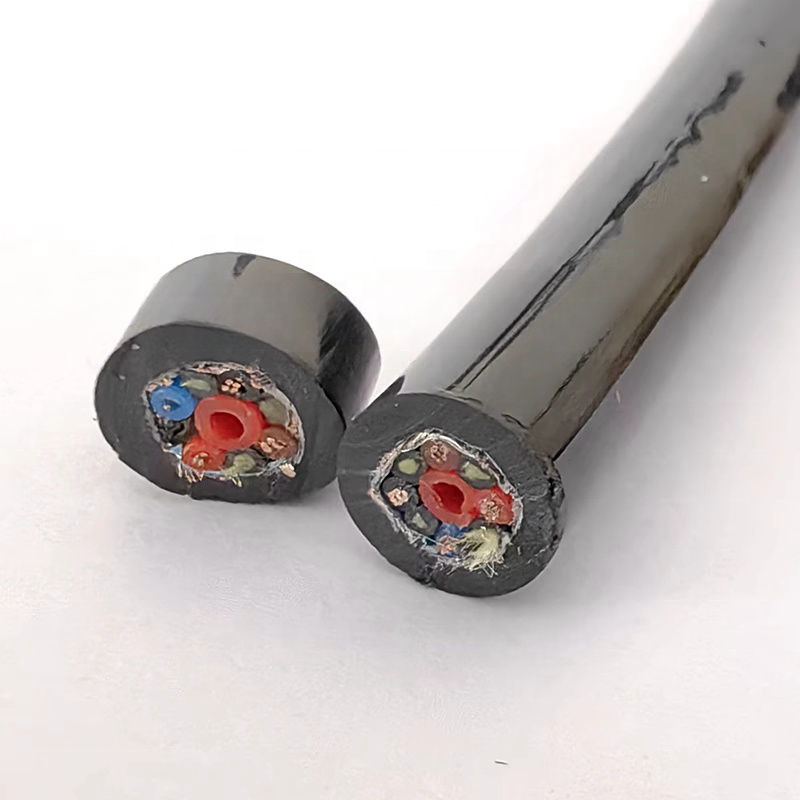
Detailed Description
What Is Pneumatic Air Duct Composite Cable?
A pneumatic air duct composite cable integrates one or more flexible air hoses with electrical power, control, and signal conductors in a single outer jacket — one cable that delivers compressed air, electrical power, and control signals to a pneumatic actuator, robotic gripper, or automated tool. It replaces the separate air hose and electrical cable that would otherwise run together from the machine's valve manifold to the actuator, tangling, snagging, and requiring separate cable management.
The composite cable is defined by its most sensitive element — the air hose. The hose must not kink when the cable bends in the drag chain or robot arm cable carrier. The hose must not collapse under the compression of the cable's own outer jacket or the compression from adjacent cables in the carrier. And the hose must maintain its burst pressure rating after millions of flex cycles in the dynamic cable application. The composite cable's bend radius, core assembly design, and jacket thickness are all engineered around the air hose's mechanical requirements.
Why Choose Yichi Pneumatic Composite Cables
- Custom configurations — designed to your end effector or machine schematic: Specify the air hoses (count, OD, working pressure), the electrical conductors (power, control, signal), and the jacket material. Yichi engineers the core assembly, selects the air hose type (PU or PA), and manufactures the composite cable to your specification
- PU air hose as standard — flexible, kink-resistant, abrasion-resistant: PU is the preferred hose material for dynamic applications (drag chain, robot arm) because it combines flexibility, kink resistance, and abrasion resistance. PA (nylon) hose is available for higher-pressure and chemically aggressive applications where the reduced flexibility is acceptable
- PUR outer jacket — the standard for dynamic composite cable: The PUR jacket provides the flex life, oil/coolant resistance, and cold-flex performance that pneumatic composite cable in a drag chain or robot arm requires. PVC jackets are not specified for dynamic applications — they crack from flex fatigue and degrade from oil exposure
- Verified hose burst pressure — hydrostatic tested: The air hose(s) in the composite cable are tested for burst pressure per ISO 1402 on the hose material. The burst pressure must exceed 3× the rated working pressure — this is a safety requirement for pneumatic systems operating at 6–10 bar in proximity to operators
Air Hose Material — PU versus PA
The air hose element is polyurethane (PU) or polyamide (PA, nylon 12). PU (Shore A 85-95) is the standard material for dynamic pneumatic service at 6-10 bar compressed air and vacuum to -0.9 bar, offering flexibility, kink resistance, and abrasion resistance. PA is specified for higher-pressure service at 10-20 bar where better chemical resistance is required; it is less flexible than PU and suits fixed or semi-fixed installations. The hose outer diameter is 4, 6, 8, 10, or 12 mm, with wall thickness 1.0-2.0 mm for PU and 0.75-1.5 mm for PA, selected for the actuator's air consumption and required flow rate. Each hose is verified for burst pressure above 3× the rated working pressure by a hydrostatic test per ISO 1402.
Hose Configuration for Double-Acting Cylinders
A double-acting pneumatic cylinder needs one air path to extend and one to retract, so the composite cable carries two hoses for the standard double-acting actuator, one for extend (blue) and one for retract (red), or per the machine builder's colour code. One, two, three, or four hoses can be built into a single cable. The colour-coded hose ends connect straight to the cylinder ports without confusion, which is what keeps the pneumatic and electrical connection to the end effector in one managed assembly.
Core Assembly and Kink Resistance
The air hose(s), power conductors, control cores, and signal pairs are concentrically stranded with the hose at or near the centre of the core. Centring the hose protects it and maintains a circular hose cross-section through the cable bend radius, and the controlled bend radius of the composite (10× the cable outer diameter while flexing) prevents the hose from kinking. A kinked hose blocks air flow and stalls or destabilizes the actuator, so the construction is engineered to avoid that failure. The PUR outer jacket (Shore A 85-90, halogen-free) provides the flex life, oil and coolant resistance, and cold-flex to -40°C that the drag-chain and robot-arm environment demands; overall cable diameter is typically 10-35 mm depending on hose count, hose size, and conductor count.
Electrical Conductors and Signal Pairs
The electrical side carries power conductors (0.6/1 kV, 1.5-16 mm²) for the gripper motor, solenoid valve, and auxiliary equipment; control cores (300/500 V, 0.5-2.5 mm²) for solenoid-valve control, sensor power, and I/O; and optional individually shielded twisted-pair signal wires (0.22-0.75 mm²) for position, pressure, and encoder feedback. Together the air and electrical elements deliver compressed air, power, and control to the actuator in a single cable routed through the machine's drag chain.