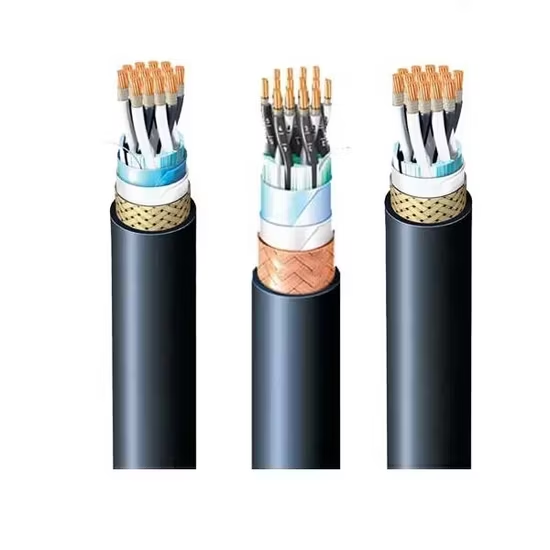
Detailed Description
What Is a CEFR / NEK 606 Marine Cable?
CEFR and NEK 606 are two of the most widely specified marine cable standards in the world — CEFR originates from Chinese shipbuilding practice, and NEK 606 is the Norwegian standard for offshore oil and gas installations. A cable manufactured to both specifications meets the requirements of shipyards and offshore operators across Asia and the North Sea — the two largest marine and offshore markets.
The name CEFR encodes the cable's construction in the Chinese standard system:
| Letter | Chinese | Meaning |
|---|---|---|
| C | 船用 (chuan-yong) | Shipboard / marine use |
| E | 乙丙橡胶 (yi-bing xiang-jiao) | EPR (ethylene propylene rubber) insulation |
| F | 阻燃 (zu-ran) | Flame retardant |
| R | 软 (ruan) | Flexible conductor (Class 5 fine stranded for control cables; Class 2 for power cables) |
NEK 606 — formally NEK TS 606 — is a Norwegian technical specification for halogen-free, mud-resistant cables used in offshore oil and gas installations. It mandates the same fire safety performance as CEFR (bundled flame retardant to IEC 60332-3-22) with the additional requirement of halogen-free construction and resistance to drilling fluids — essential for cables on drilling rigs and wellhead platforms where the cable may be exposed to oil-based and water-based drilling mud.
CEFR vs NEK 606 — What the Dual Standard Means
| Requirement | CEFR | NEK 606 | Yichi Dual-Standard Cable |
|---|---|---|---|
| Insulation | EPR, 90°C | EPR or XLPE, 90°C | EPR, 90°C — meets both |
| Sheath | CSP (Hypalon) or PCP (neoprene) | Halogen-free CSP or special LSZH compound | CSP (Hypalon) — meets both; halogen-free per NEK 606 |
| Flame retardant | IEC 60332-3-22 Cat A | IEC 60332-3-22 Cat A | Passes Cat A — meets both |
| Halogen content | Not specifically required by CEFR | ≤0.5% HCl per IEC 60754-1 | ≤0.5% — meets NEK 606 |
| Mud resistance | Not required by CEFR | Required by NEK 606 — drilling fluid exposure test | CSP resists oil-based and water-based mud — meets NEK 606 |
| Oil resistance | Required — IRM 902/903 | Required | CSP — meets both |
| Conductor | Tinned copper | Tinned copper | Tinned copper — meets both |
The dual-standard cable covers the requirements of both specifications. For a shipyard in Asia building a vessel for a European operator, a dual-standard CEFR/NEK 606 cable satisfies both the local classification society (CCS) and the operator's corporate specification (NEK 606). For an offshore project in Southeast Asia, the same cable meets the regional standard (CEFR) while providing the enhanced fire and mud resistance of the North Sea standard (NEK 606).
Application Analysis
- Commercial vessel power distribution: Main and emergency switchboard feeders, section board supply cables, and motor control centre power cables on tankers, bulk carriers, container ships, and cruise vessels built to CEFR specification
- Offshore support vessel (OSV) and platform supply vessel (PSV): Deck equipment power (towing winch, anchor handling winch, crane), engine room auxiliary power, and dynamic positioning (DP) system motor feeders
- Drilling rig electrical systems: Top drive motor power, mud pump motor feeders, drawworks motor cables, and BOP control system power on jack-up rigs, semi-submersibles, and drillships per NEK 606
- FPSO topside power: Process equipment (separator, compressor, pump motor) power cables, offloading pump motor feeders, and flare system cables
- Emergency and safety-critical circuits: Fire pump motor power, emergency generator output cables, and fire damper actuator power — circuits that must maintain integrity during a fire
Why Choose Yichi for CEFR/NEK 606 Marine Cables
- Manufactured to both standards — verified by in-house testing: The same cable passes both CEFR and NEK 606 requirements. Yichi provides test reports for bundled flame (IEC 60332-3-22), halogen content (IEC 60754-1), smoke density (IEC 61034-2), oil resistance, and mud resistance
- EPR insulation as standard: EPR offers superior flexibility, heat resistance (90°C continuous), and water tree resistance compared to XLPE. For marine cables that are installed through bulkhead penetrations and around tight bend radii, EPR's flexibility is a practical installation advantage
- CSP (Hypalon) sheath for mechanical and chemical protection: CSP provides the best combination of flame retardance, oil resistance, mud resistance, ozone resistance, and UV resistance of any marine cable sheath material — and it meets the halogen-free requirement of NEK 606
- Tinned copper for long-term corrosion resistance: Bare copper in a marine cable junction box develops green corrosion within months. Tinned copper maintains low contact resistance for the service life of the vessel
- Full production batch testing per both standards: Conductor resistance, insulation resistance, high-voltage test, and sheath tensile/elongation are measured on every production length — not just type-tested on a representative sample