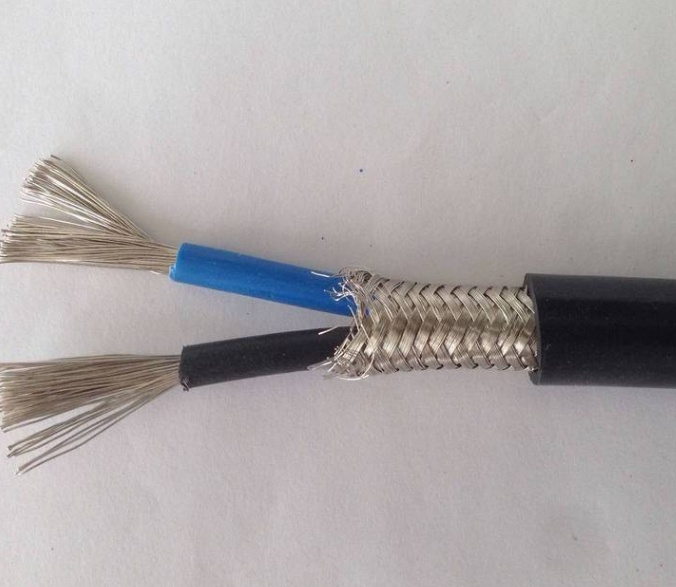
Detailed Description
What Is a Marine Communication Cable?
A marine communication cable is a fire-retardant, halogen-free shielded multi-pair cable designed for telephone, intercom, data, and control communication circuits on board ships, offshore platforms, and marine installations. It is distinguished from an industrial communication cable by its mandatory compliance with marine fire safety regulations — the International Convention for the Safety of Life at Sea (SOLAS) and the IEC 60092 series of standards for electrical installations on ships.
In a shipboard fire, the cables themselves are a significant fire load — hundreds of kilometres of cable run through a large vessel. Cables that propagate fire along cable trays, emit dense smoke that obscures escape routes, and release corrosive hydrogen chloride gas that destroys electrical and electronic equipment are unacceptable in the marine environment. The marine communication cable is designed to address all three:
- Fire propagation — the cable passes IEC 60332-3-22 Category A, the bundled cable fire test. Multiple cables are mounted on a vertical tray and exposed to a flame source; the fire must not propagate beyond 2.5 metres above the burner
- Smoke emission — the cable passes IEC 61034-2, the smoke density test. Light transmittance through the smoke from burning cable samples must be ≥60%, ensuring that escape route signage remains visible
- Halogen gas emission — the cable passes IEC 60754-1/2, the halogen content and corrosivity test. HCl emission must be ≤0.5%, and the pH of the combustion gas solution must be ≥4.3 (not strongly acidic)
Marine vs Industrial Communication Cable — Why Marine Specification Matters
| Parameter | Marine Communication Cable (IEC 60092) | Industrial Communication Cable (VDE/UL) |
|---|---|---|
| Fire retardant (bundled) | IEC 60332-3-22 Category A — mandatory | Usually IEC 60332-1-2 only (single cable); bundled test not standard |
| Halogen content | ≤0.5% HCl — mandatory for enclosed spaces | Not typically specified for industrial cables |
| Smoke emission | IEC 61034-2, ≥60% transmittance | Not typically specified |
| Oil resistance | IEC 60811-404, IRM 902 + IRM 903 | Optional — specified per application |
| Classification society approval | DNV, ABS, LR, BV, CCS type approval available | Not applicable |
| Voltage rating | 250 V per IEC 60092-376 | 300/500 V per VDE 0812 |
| Typical application | Ship and offshore platform — where crew safety depends on cable fire performance | Factory and building — where fire codes are less stringent |
An industrial cable installed on a vessel — even one with a PUR jacket and high-quality shield — does not meet the fire safety requirements of SOLAS and the vessel's classification society. The marine cable's LSZH compound is specified for the safety of the crew, not the convenience of the installer.
Pair Count Selection for Shipboard Communication Systems
| Pair Count | Typical Shipboard Application | System |
|---|---|---|
| 1–2 pairs | Individual telephone drop, NMEA 0183 serial data | Cabin telephone, GPS to ECDIS, AIS to radar |
| 4–6 pairs | Branch exchange trunk, engine room sensor group | PBX trunk between decks, engine monitoring sensor cluster |
| 8–12 pairs | Main communication trunk, PA zone cable | Bridge to engine control room telephone trunk, PA/GA zone amplifier input |
| 16–24 pairs | Central exchange trunk, multi-system consolidation | Main PBX cable between bridge and accommodation block; combined telephone + data + control trunk |
The core identification follows IEC 60189-2 for telecommunication cables — each pair has a unique colour combination (ring-marked on a base colour) that is unambiguous across the full pair-count range. In the confined cable trays of a ship's cable transit system, unambiguous pair identification without needing to tone out each pair saves commissioning time and reduces wiring errors.
Application Analysis: Where Marine Communication Cables Are Used
- Shipboard internal communication: Telephone, talkback, and intercom trunk cables between the bridge, engine control room (ECR), cargo control room, and accommodation spaces on tankers, container ships, cruise vessels, and naval ships
- Engine room monitoring and control: Shielded twisted-pair cables connecting engine temperature sensors, pressure transmitters, flow meters, and vibration sensors to the machinery control system (MCS) and alarm monitoring system in the engine control room
- Navigation and bridge systems: NMEA 0183 serial data cables between GPS, gyrocompass, speed log, echo sounder, radar, ECDIS, and autopilot on the bridge — each system requiring a dedicated shielded pair for noise-free data communication
- Fire detection and safety systems: Addressable fire detection loops, manual call points, smoke and heat detector wiring, and fire door release circuits — the cable's halogen-free construction is essential in these life-safety systems
- Public Address / General Alarm (PA/GA): Multi-pair cables carrying audio and control signals from the PA/GA central unit to zone amplifiers and speaker circuits throughout the vessel — the system used for crew mustering and emergency instructions per SOLAS
- Offshore platform telecom: Platform telephone, PAGA, LAN, CCTV, and security system cables on fixed and floating offshore oil and gas platforms and offshore wind substations — the same fire safety standards as shipboard, applied to a stationary installation
Why Choose Yichi for Marine Communication Cables
- Manufactured to IEC 60092 marine standards with fire test certification: IEC 60332-3-22 (bundled flame), IEC 61034-2 (smoke density), and IEC 60754-1/2 (halogen content and corrosivity) — the three mandatory marine fire safety tests, with test reports available for each cable type
- Halogen-free LSZH compound formulated for marine duty: The sheath compound is not just halogen-free — it is formulated for oil resistance (IRM 902 + IRM 903), mechanical toughness, and flexibility at marine operating temperatures. A general-purpose LSZH compound that passes the fire tests but cracks after six months in the engine room is not acceptable
- Classification society type approval support: DNV, ABS, Lloyd's Register, Bureau Veritas, CCS — Yichi provides the technical documentation and test reports required for type approval by the vessel's classification society, and manages the approval process alongside cable production
- Individually shielded pairs for crosstalk isolation: Each pair carries its own foil shield and drain wire. In a 24-pair trunk cable carrying analog telephone, RS-485 data, and NMEA serial signals simultaneously, per-pair shielding prevents the RS-485 modem tones from being audible on the telephone circuits
- Factory-direct manufacturing for shipyard project quantities: For new-build vessel projects requiring kilometres of marine communication cable, Yichi provides consistent quality, full fire test documentation per batch, and competitive project pricing without the marine equipment distributor markup