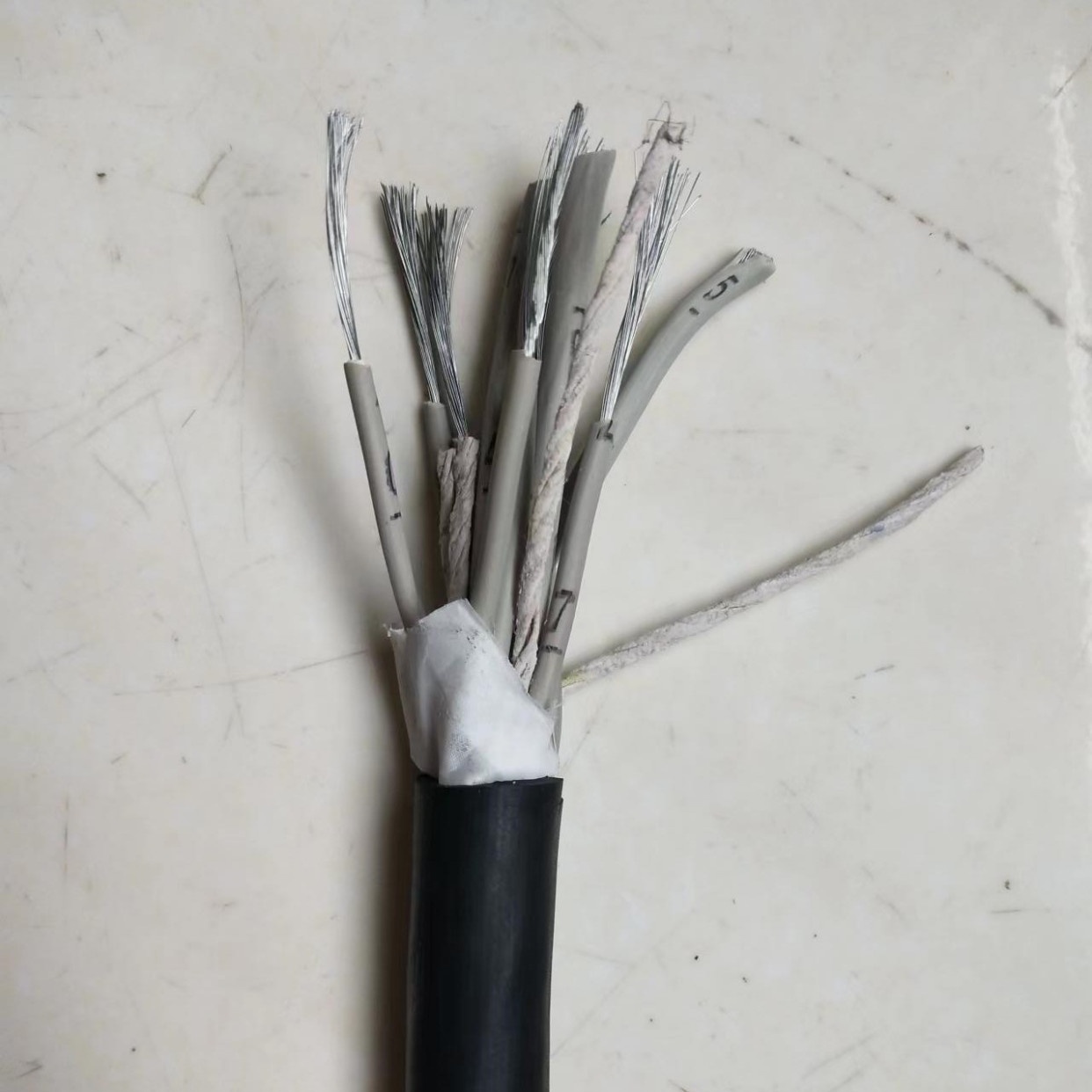
Detailed Description
What Is a Marine Control Cable?
A marine control cable is the shipboard equivalent of an industrial shielded control cable — a fire-retardant, halogen-free multi-core cable that carries the switching signals for motor starters, contactor coils, solenoid valves, damper actuators, and other control devices throughout a vessel or offshore platform. It is distinguished from an industrial control cable by mandatory compliance with marine fire safety regulations (SOLAS and the IEC 60092 series).
On a vessel, the control cable environment is more demanding than a factory:
- Fire safety: A cable fire in an enclosed machinery space threatens the entire vessel. Every cable must pass IEC 60332-3-22 (Category A bundled fire test) and emit minimal smoke and no corrosive halogen gases
- Electrical noise: The cable routes share trunking and penetrations with VFD motor power cables, radar waveguides, and radio antenna feeders. The shield must prevent false triggering of relay and contactor circuits in this electrically dense environment
- Mechanical: Cable runs pass through watertight bulkhead penetrations, fire-rated cable transits, and vibration-intensive machinery spaces. The cable construction must survive this routing without jacket cracking or shield damage
Marine Control Cable vs Marine Communication Cable
| Parameter | Marine Control Cable | Marine Communication Cable |
|---|---|---|
| Primary circuit | Motor starters, contactors, solenoid valves, actuators (switching and power-level signals) | Telephone, intercom, data, instrumentation (low-level signals) |
| Voltage rating | 0.6/1 kV | 250 V |
| Conductor size | 0.75–6 mm² (sized for control circuit current) | 0.5–2.5 mm² (sized for signal current) |
| Construction | Multi-core concentric, overall shield | Individually shielded pairs + overall shield |
| Capacitance critical? | No — control circuits switch at low frequency | Yes — for analog telephone and high-speed data |
| Core count | 2–24 (matched to control circuit density) | 1–24 pairs (each pair is a communication channel) |
| Fire safety | Identical — both meet IEC 60332-3-22, IEC 61034-2, IEC 60754-1/2 | Identical |
Application Analysis
- Engine room motor control: The start/stop, running feedback, and fault contacts of every pump, fan, and compressor in the machinery spaces are wired back to the machinery control system via marine control cable — the ship's equivalent of a factory PLC I/O network
- Cargo and ballast system control on tankers: Hydraulic valve actuators, tank level sensors, and pump starters distributed across the deck and in the pump room are controlled from the cargo control room via multi-core control cables that survive the deck environment
- HVAC damper and valve actuation: Fire dampers, smoke extraction dampers, and accommodation ventilation control circuits — safety-critical systems that must continue to operate during a fire event
- Offshore platform wellhead control: Subsurface safety valve (SSSV) control, master valve actuation, and chemical injection pump control on offshore wellhead platforms — the control cable is part of the platform's safety instrumented system
Why Choose Yichi for Marine Control Cables
- Full IEC 60092 marine fire safety compliance: The three mandatory tests — bundled flame (IEC 60332-3-22), smoke density (IEC 61034-2), and halogen content (IEC 60754-1/2) — with test reports per cable type
- 0.6/1 kV EPR/XLPE insulation for control circuit duty: Higher voltage class and temperature rating than a typical industrial control cable, matching the shipboard power distribution environment where control cables share routing with 440/690 V power cables
- Classification society type approval on request: ABS, DNV, LR, BV, CCS — Yichi manages the approval process and provides the technical documentation required by the vessel's flag state and class
- Factory-direct supply for shipyard projects: New-build vessel and platform projects with kilometres of marine control cable in the cable schedule — consistent quality, full fire test documentation per production batch, competitive project pricing