Detailed Description
What Is a Motor Connection Cable?
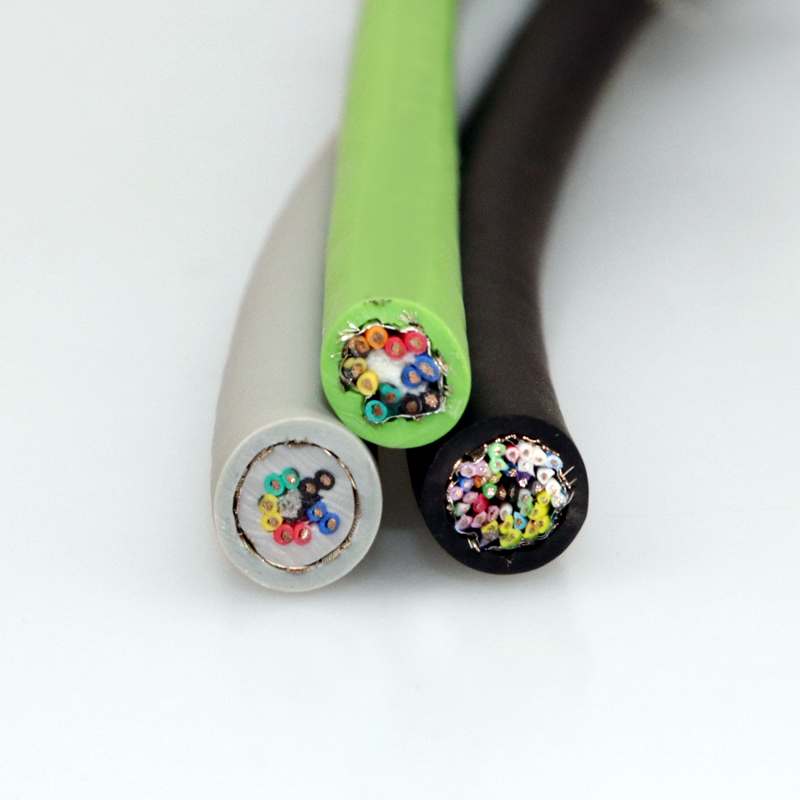
A motor connection cable is the power wiring that carries the three-phase supply voltage from the drive, contactor, or electrical panel to the motor terminal box. Unlike general building wire — which is designed for fixed installation in conduit — a motor connection cable is engineered for the specific electrical, mechanical, and environmental demands of industrial motor circuits:
- 0.6/1 kV voltage rating matches the standard low-voltage motor supply (400 V 3-phase), with a 3 500 V AC test voltage providing a safety margin against switching transients and voltage spikes
- Class 6 extra-fine stranded copper delivers the flex life needed on moving machine axes, in drag chains, and in cable carrier systems where ordinary stranded wire would fatigue and break
- Three-phase plus earth (3P+PE) covers the standard star or delta motor connection, while 4P+PE adds a neutral conductor where the application requires it
Motor Connection Cable vs Motor Power Cable — When to Use Each
| Parameter | Motor Connection Cable | Motor Power Cable (VFD) |
|---|---|---|
| Primary application | General motor power wiring, contactor-fed motors, non-critical servo axes | VFD and servo drive output, PWM voltage, high dV/dt |
| Voltage rating | 0.6/1 kV | 0.6/1 kV |
| Insulation system | Single-layer TPE or EPR (90°C) | Multi-layer (EPR + semi-conductive layers for partial discharge resistance) |
| Shield | Optional braid shield | Standard braid shield; symmetric 3P+3PE on request |
| VFD suitability | Not recommended for PWM output > 500 V DC bus | Specifically designed for PWM inverter output |
| Cost | Lower — single-layer insulation, shield optional | Higher — multi-layer insulation, shielded standard |
The decision comes down to the drive type: if the motor is powered from a VFD or servo drive with PWM output voltage, the motor power cable with its multi-layer insulation system is the correct choice. For motors fed from contactors, soft starters at standard line frequency, or DC drives, the motor connection cable delivers the needed electrical and mechanical performance without the additional cost of the VFD-rated construction.
Conductor Configuration — 3P+PE vs 4P+PE
| Configuration | Cores | Typical Connection | Application |
|---|---|---|---|
| 3P+PE | 4 (brown/black/grey + green/yellow) | 3-phase motor star or delta (no neutral) | Standard induction and servo motors |
| 4P+PE | 5 (brown/black/grey/blue + green/yellow) | 3-phase motor with star-point neutral brought out | Motors requiring star-point neutral access or 4-wire distribution |
| 3P+3PE | 6 (3× phase + 3× PE) | Symmetric earth distribution for VFD | Reduces shield current and bearing currents in VFD applications (on request) |
Core identification follows HD 308 S2 (IEC 60446), with the green/yellow protective earth conductor always present. For multi-motor or multi-cable installations, black-numbered cores (1, 2, 3, PE) simplify documentation and fault-finding on the factory floor.
Shielded vs Unshielded Motor Connection Cable
In industrial motor circuits, shielding is not always required — but several common situations make it a practical choice:
- Installations near VFD cables: If a contactor-fed motor cable runs in the same tray or conduit as a VFD output cable, the PWM noise coupled onto the unshielded motor cable can cause nuisance trips of the motor protection relay and corrupt sensor signals on nearby cables. An overall braid shield reduces this coupling by 20–30 dB
- Long parallel cable runs: When several motor cables run side by side for tens of metres, capacitive crosstalk between phases — especially asymmetric at partial load — can induce circulating currents. A shield bonded at both ends provides a defined return path
- EMC compliance in CE-marked machinery: The EMC Directive (2014/30/EU) applies to the machine as a system. A shielded motor cable connected with a 360° EMC gland at the panel and the motor frame is one of the simplest ways to meet radiated and conducted emission limits
Application Analysis: Where Motor Connection Cables Are Used
- General machinery: Conveyor drive motors, pump motors, fan motors, and agitator motors on standard machine frames — where the motor is contactor-fed or soft-started, and the cable follows a moving section of the machine
- Light positioning axes: Pick-and-place units, rotary indexers, and linear transfer systems where the motor moves with the axis but the drive is a standard servo or vector drive with modest PWM frequency
- Machine tool auxiliary axes: Coolant pump motors, hydraulic power pack motors, chip conveyor motors — auxiliary motors that move with the machine axis and need flexible cabling
- Elevator motor power: Lift motor power cables that form part of the traveling cable bundle between the machine room and the car; the Class 6 conductors survive the repeated bending of the elevator travel cycle
- Panel-to-motor wiring on moving machinery: Flexible connection from the electrical cabinet to a motor mounted on a sliding, rotating, or reciprocating machine element
- Retrofit and replacement: Direct replacement for ageing PVC motor cables on legacy machinery — upgrading to PUR jacket and Class 6 conductor extends service life in moving applications
Why Choose Yichi for Motor Connection Cables
- Class 6 copper standard: Every motor connection cable ships with extra-fine stranded Class 6 conductors — the right construction for moving-machine applications, not the Class 5 "flexible" compromise found in many general-purpose cables
- Two jacket options with clear guidance: PUR for drag chain, coolant, and outdoor duty; PVC for fixed installation and cost-sensitive applications — we help you choose based on the actual mechanical environment
- Shield as an option, not a forced upsell: Your application may not need a shield, and we will not charge you for one if it does not. When shielding is required, our braid is measured for coverage (≥85%) and the braid angle is controlled for the right flexibility-versus-shielding trade-off
- HV tested on every length: 3 500 V AC core-to-core and core-to-shield on every production length — no batch testing; every cable that leaves the factory has passed the full voltage test
- Factory-direct manufacturing: No distributor markups, full material traceability from copper ingot to finished cable, and custom core counts, cross-sections, and jacket materials on request with short lead times