Detailed Description
What Is Automotive Wire & Cable?
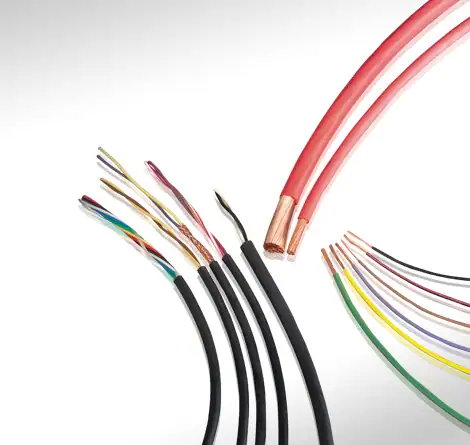
Automotive wire is a thin-wall, single-core insulated conductor designed specifically for the low-voltage (12–24 V DC) electrical systems of road vehicles — the wire that forms the wiring harness connecting every electrical and electronic component in a car, truck, bus, or motorcycle. It is defined by ISO 6722 (international) and SAE J1128 (North America), which specify the conductor construction, insulation materials, wall thicknesses, temperature classes, and the rigorous mechanical, thermal, and chemical test suite that automotive wire must survive.
Automotive wire looks superficially like general-purpose hookup wire, but the specifications are fundamentally different. A vehicle wiring harness operates in an environment that no building wire experiences: continuous vibration at 10–2 000 Hz at up to 20 g acceleration, temperature cycling from -40°C winter cold-start to +125°C engine compartment hot-soak, exposure to engine oil, fuel, brake fluid, coolant, and road salt solution, and decades of thermal and mechanical cycling without failure. The thin-wall insulation (0.2–0.4 mm) must provide reliable electrical insulation at the 12 V DC operating voltage while being light enough to contribute minimally to the vehicle's weight (a modern vehicle contains 1–3 km of wire weighing 20–50 kg — every gram of wire weight saved reduces the vehicle's fuel consumption and CO₂ emissions over its life).
Temperature Classes T1–T4 — Where to Use Each
| Class | Max Temp | Insulation | Typical Wire Location | Example Circuits |
|---|---|---|---|---|
| T1 | 85°C | PVC | Passenger compartment, trunk, doors | Interior lights, window motors, door locks, seat adjustment, infotainment, instrument cluster |
| T2 | 100°C | PVC (elevated temp) | General engine compartment, away from engine block | Headlights, radiator fan, horn, windshield washer pump, ABS wheel speed sensors (wheel well) |
| T3 | 125°C | XLPE | Engine hot-zone, on or near engine block | Fuel injectors, ignition coils, camshaft/crankshaft position sensors, knock sensor, oil pressure sensor |
| T4 | 150°C | XLPO / Silicone | Extreme engine hot-spots | Oxygen (lambda) sensors (pre-cat and post-cat), turbocharger wastegate actuator, EGR valve, exhaust gas temperature sensor, cylinder head temperature sensor |
For a typical passenger vehicle wiring harness, the wire is predominantly T1 and T2 (85–90% of the total wire length) with T3 for the engine harness connections and T4 for a small number of sensor wires in the hottest engine locations. The temperature class is selected for the maximum temperature that the wire will experience at its routed position in the vehicle — measured or calculated from the vehicle's thermal model during the harness design phase.
Why Choose Yichi Automotive Wire & Cable
- ISO 6722 / SAE J1128 tested — the definitive automotive wire standards: The wire is type-tested for the full ISO 6722 test schedule: conductor resistance, insulation thickness, spark test, dielectric withstand, thermal ageing (3 000 h at rated temperature), cold bend (-40°C), scrape abrasion, fluid resistance (all standard ISO test fluids), and flame retardance. The test report verifies the wire's performance — not the material supplier's data sheet claims
- Thin-wall insulation — minimising harness weight and volume: The thin-wall insulation (0.20–0.28 mm for the standard ISO thin-wall class) produces the smallest possible wire OD for a given conductor cross-section. This is critical for the dense wiring harness bundles in modern vehicles where hundreds of wires must pass through restricted apertures in the vehicle body and the collective wire weight directly affects vehicle fuel consumption and emissions
- T1–T4 temperature classes — the full automotive temperature spectrum: One manufacturer for the complete vehicle wiring harness wire inventory. T1/T2 PVC for the body and general engine harnesses; T3 XLPE for the engine hot-zone connections; T4 XLPO for the hottest engine sensor wiring. Consistent quality, consistent dimensional tolerances, consistent colour coding across all four temperature classes
- International colour coding per vehicle manufacturer specification: Any base colour + stripe combination; the colour is integral to the insulation compound — it does not fade, rub off, or become illegible after exposure to engine compartment temperatures, oil, and UV. The colour coding is the installer's primary wire identification — it must remain clear and unambiguous for the vehicle's service life
- Vehicle manufacturer approval on request: Yichi automotive wire can be supplied with the specific approval (Freigabe) of the vehicle manufacturer — VW, BMW, Daimler, Ford, GM, Stellantis, Toyota, Honda, and others. The manufacturer-specific approval verifies that the wire meets that manufacturer's specific additional requirements beyond the ISO 6722 baseline