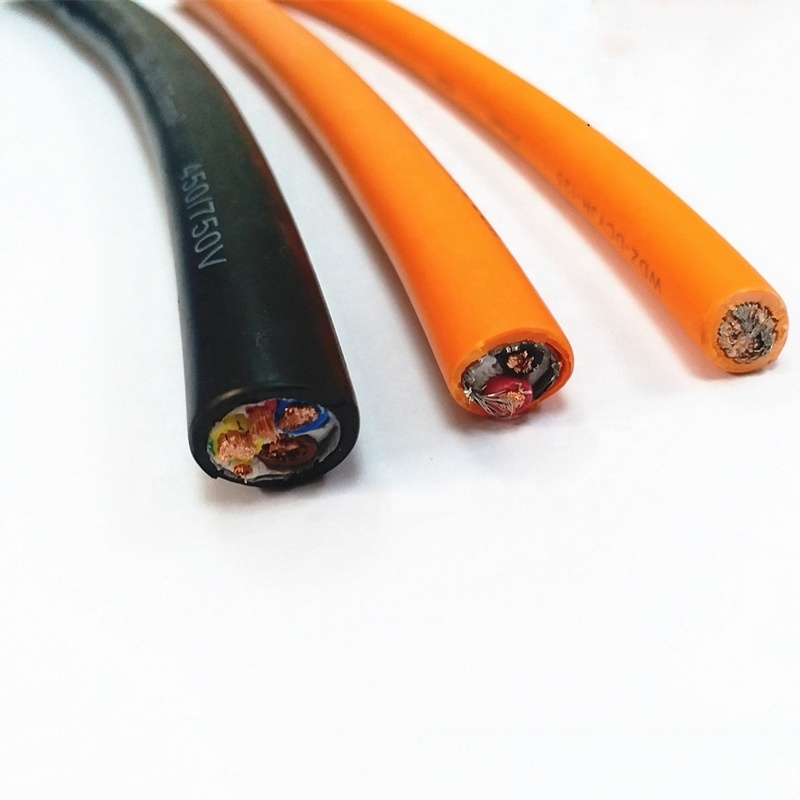
EV Charging Cable (Mode 2 & Mode 3) — IEC 62196 / EN 50620 TPE/PUR Jacketed Type 1 SAE J1772 and Type 2 IEC 62196-2 EV Charging Cable with Integrated Control Pilot and Proximity Pilot, 16 A to 32 A Single-Phase and Three-Phase, for Portable and Fixed AC Electric Vehicle Charging
EV Charging & Renewable Energy Cables /EV Charging Cable

EV Charging Cable (Mode 2 & Mode 3) — IEC 62196 / EN 50620 TPE/PUR Jacketed Type 1 SAE J1772 and Type 2 IEC 62196-2 EV Charging Cable with Integrated Control Pilot and Proximity Pilot, 16 A to 32 A Single-Phase and Three-Phase, for Portable and Fixed AC Electric Vehicle Charging

EV charging cable Mode 2 & Mode 3: IEC 62196 / EN 50620 TPE or PUR jacket, Type 1 (SAE J1772) or Type 2 (IEC 62196-2). 16A/32A, single-phase 3.7–7.4kW, three-phase 11–22kW. Integrated CP and PP pilot conductors. Vehicle run-over resistant, cold-flex -40°C, UV/ozone/oil resistant. TUV, CE, RoHS.

Key Features

IEC 62196-1/2 and EN 50620 / IEC 62893 compliant — the international standards for EV charging cables covering Mode 2 (portable charger with IC-CPD) and Mode 3 (fixed charging station) connection methods; the cable is type-tested for the full EV charging duty cycle
Type 1 (SAE J1772, North American/Japanese standard) and Type 2 (IEC 62196-2, European standard) connector configurations — the cable is terminated with the vehicle connector at one end and the charger connector or IC-CPD at the other end, ready for installation into the charging equipment or as a replacement cable
Integrated control pilot (CP) and proximity pilot (PP) conductors — the CP conductor carries the PWM communication signal between the vehicle and the charger that controls the charging current; the PP conductor signals the cable's current rating to the vehicle through a resistor in the connector, preventing overcurrent
Power conductors: 3-core for single-phase (L, N, PE) or 5-core for three-phase (L1, L2, L3, N, PE) — 16 A (3.7 kW single-phase / 11 kW three-phase) or 32 A (7.4 kW single-phase / 22 kW three-phase) per IEC 61851 Mode 3 standards
TPE (thermoplastic elastomer) or PUR (polyurethane) outer jacket — TPE for standard indoor/outdoor charging cables with excellent flexibility and cost-effectiveness; PUR for premium public charging station cables with superior oil, chemical, UV, and abrasion resistance for high-traffic public charging environments
Vehicle run-over resistant — tested to EN 50620 Annex D for mechanical load resistance including vehicle drive-over; the cable survives being repeatedly driven over by passenger vehicles in domestic driveway and public parking bay charging scenarios without conductor damage or insulation breakdown
High-flex life — >10 000 charge cycles (plug/unplug and cable handling) per IEC 62893-1 mechanical testing; the cable is designed for the daily handling of EV charging: dragging across concrete, coiling, uncoiling, and repeated connector insertion
Temperature range -40°C to +60°C (PUR/TPE flexible) — outdoor rated for all-weather charging in any climate; the cable remains flexible at Arctic winter temperatures and does not soften or degrade in summer sun on black asphalt at 60°C surface temperature

Applications

Mode 2 portable EV charger (IC-CPD) — 16 A single-phase cable with Type 2 vehicle connector and integrated in-cable control and protection device (IC-CPD) with mains plug for charging from domestic socket outlets; the emergency/travel charger supplied with the vehicleMode 3 fixed AC charging station — 16 A or 32 A single-phase or three-phase cable permanently connected to a wallbox or charging post; the standard installation for home, workplace, and public AC charging stationsPublic AC charging stations — 32 A three-phase Type 2 cable for public on-street, car park, and destination charging stations where multiple vehicle types must be accommodated and the cable is subject to intensive daily use by the publicWorkplace and fleet depot charging — 16 A or 32 A three-phase charging cables for overnight fleet vehicle charging in company car parks, bus depots, and logistics centers where multiple vehicles charge simultaneouslyResidential home charging — 16 A or 32 A single-phase Type 2 cable for dedicated home wallbox installations; the standard specification for overnight home EV charging per IEC 61851-1EV charging cable replacement — OEM-specification replacement cable for damaged or worn charging cables on existing charging stations; the cable is supplied with stripped and tinned conductor ends for connection to the charging station terminals

Technical Specifications

Standards — Cable EN 50620: Electric cables — Charging cables for electric vehicles (up to 1 kV AC / 1.5 kV DC); IEC 62893: Charging cables for electric vehicles of rated voltages up to and including 0.6/1 kV; HD 639 (harmonized)
Standards — Connector IEC 62196-1 (general EV connector requirements); IEC 62196-2 (Type 2 connector for AC charging); SAE J1772 (Type 1 connector, North America/Japan)
Standards — Charging System IEC 61851-1 (EV conductive charging system — general); IEC 61851-1 Mode 2 (portable charger with IC-CPD); IEC 61851-1 Mode 3 (fixed AC charging station)
Charging Mode Mode 2 (portable, IC-CPD in-cable control box, ≤32 A, from domestic or industrial socket); Mode 3 (fixed AC charging station, ≤63 A per IEC 61851, typically 16 A or 32 A for residential and public AC)
Connector Type — Vehicle End Type 1 (SAE J1772, 5-pin, single-phase up to 32 A, North America/Japan); Type 2 (IEC 62196-2, 7-pin, single-phase and three-phase up to 63 A, Europe/global)
Connector Type — Charger End Open-ended (stripped and tinned for terminal connection inside the charging station); Type 2 female (for tethered cable replacement with connector); IEC 60309 industrial plug (for Mode 2 IC-CPD connection to industrial socket)
Rated Current — Standard 16 A (3.7 kW single-phase / 11 kW three-phase at 230/400 V); 32 A (7.4 kW single-phase / 22 kW three-phase at 230/400 V)
Rated Current — Extended 63 A single-phase and 63 A three-phase (43 kW) on request for higher-power AC charging stations per IEC 62196-2
Rated Voltage (U₀/U) 300/500 V (single-phase charging cable per EN 50620); 450/750 V (three-phase charging cable)
Conductor Material — Power Cores Bare copper or tinned copper; IEC 60228 Class 5 flexible stranded; 6 mm² (32 A single-phase); 6 mm² (32 A three-phase); 2.5 mm² (16 A); 10 mm² (63 A)
Conductor Material — Signal Cores Bare copper or tinned copper; IEC 60228 Class 5 flexible stranded; 0.5 mm² or 0.75 mm² for CP and PP conductors
Core Configuration — Single-Phase (3-Core + Signal) L (brown) + N (blue) + PE (green-yellow) + CP (0.5 mm², violet or white) + PP (0.5 mm², grey or white-orange); 5 conductors total in the cable
Core Configuration — Three-Phase (5-Core + Signal) L1 (brown) + L2 (black) + L3 (grey) + N (blue) + PE (green-yellow) + CP (0.5 mm²) + PP (0.5 mm²); 7 conductors total in the cable
Control Pilot (CP) Function Carries the PWM (pulse-width modulation) signal at 1 kHz from the charging station to the vehicle; the duty cycle of the PWM signal tells the vehicle the maximum available charging current (e.g., 53% duty cycle = 32 A); the vehicle controls the progression through charging states by switching resistors on the CP line
Proximity Pilot (PP) Function Connected to a resistor inside the vehicle connector that indicates the cable's current rating to the vehicle (e.g., 220 Ω = 32 A cable; 680 Ω = 16 A cable); the vehicle measures the PP resistance to determine the cable limit and prevents drawing more current than the cable is rated for
Core Insulation — Power TPE (thermoplastic elastomer) or EPR (ethylene propylene rubber); rated 90°C; the insulation must withstand the thermal load from continuous charging at rated current in an enclosed cable reel or coiled on the charger holster
Core Insulation — Signal (CP/PP) PP or PE (polypropylene/polyethylene); 0.25–0.35 mm wall; for clean signal transmission of the 1 kHz PWM and PP resistance measurement
Signal Core Shielding (Optional) The CP conductor may be individually shielded to prevent EMI coupling from the power conductors into the PWM signal, ensuring reliable vehicle-charger communication in electrically noisy charging environments
Core Assembly Concentric stranding of power cores around a central filler element; signal cores laid in the outer interstices; overall assembly filled with non-hygroscopic filler to maintain circular cross-section
Outer Jacket — TPE Thermoplastic elastomer (TPE-S or TPE-O); Shore A 75–85; black or orange; excellent flexibility at all temperatures; good oil and UV resistance; the standard jacket material for residential and light commercial EV charging cables
Outer Jacket — PUR Polyurethane (PUR TMPU); Shore A 85–90; black or orange; superior abrasion resistance (Taber <5 mg), oil/chemical resistance, and UV stability; the premium jacket material for public charging stations with intensive daily use
Jacket Color — Standard Black (discreet, UV-stable, does not show dirt — standard for fixed charging stations); Orange (high-visibility, reduces trip hazard on the ground — standard for public charging stations); custom colors available for OEM charger manufacturers
Jacket Mechanical — Vehicle Run-Over Tested per EN 50620 Annex D / IEC 62893-1; the cable is subjected to a simulated vehicle drive-over with a steel wheel at 5 000 N load; after testing, the cable must pass the high-voltage test — no conductor breakage, no insulation damage
Jacket Mechanical — Abrasion Resistance (PUR) Taber abrasion (ASTM D4060, CS-17 wheel, 1 000 g load, 1 000 cycles) ≤5 mg mass loss; standard TPE jacket ≤15 mg mass loss
Maximum DC Conductor Resistance at 20°C — Power Cores Per IEC 60228 Class 5; 7.98 Ω/km (2.5 mm², 16 A cable); 3.30 Ω/km (6 mm², 32 A cable); 1.91 Ω/km (10 mm², 63 A cable)
Maximum DC Conductor Resistance at 20°C — Signal Cores Per IEC 60228 Class 5; 39.0 Ω/km (0.5 mm²)
Insulation Resistance at 20°C ≥10 MΩ·km (minimum at 500 V DC)
Test Voltage (AC — Finished Cable) 2 500 V AC / 5 min (power cores); 2 000 V AC / 5 min (signal cores); per EN 50620
Temperature Range — Moving / Flexing -40°C to +60°C (PUR/TPE jacket); the cable remains flexible at -40°C for cold-climate outdoor charging
Temperature Range — Fixed -50°C to +90°C (PUR); -50°C to +85°C (TPE)
Temperature Range — Storage -50°C to +90°C; the cable stored in an unheated garage in winter or in direct sun on a wall-mounted charger holster in summer must survive the full temperature range without degradation
Minimum Bend Radius 5× cable OD (flexing, coiling, and uncoiling during charging); 3× cable OD (fixed routing inside the charger)
Flex Life — Plug/Unplug Cycles >10 000 cycles per EN 50620 / IEC 62893-1 mechanical endurance testing; the cable must survive the mechanical stress of daily charging connector insertion
Flex Life — Cable Bending >50 000 bending cycles at 5× cable OD; per EN 50620 / IEC 62893-1 flexing test; simulating the coiling and uncoiling of the cable on the charger holster
Oil / Chemical Resistance (PUR) IEC 60811-404; excellent — resistant to engine oil, brake fluid, road salt, and de-icing chemicals encountered in the vehicle charging environment
Flame Retardant IEC 60332-1-2; EN 50620 classification; the cable must self-extinguish in the event of an electrical fault
Halogen-Free (PUR / TPE) IEC 60754-1; both PUR and TPE jacket materials are halogen-free — no HCl, HBr, or HF emission in a fire
UV / Weather Resistance Excellent — the black or orange jacket compound is UV-stabilized for outdoor exposure throughout the cable's service life; tested per ISO 4892-2 (xenon arc weathering)
Cable Lengths (Standard) 5 m (residential wallbox); 7.5 m (residential and commercial charging stations); 10 m (public charging stations for flexible parking bay access); custom lengths 2–25 m on request
Current Rating Derating — Coiled Cable When the charging cable is coiled on the charger holster during standby, the thermal dissipation is reduced; for continuous charging at full rated current, the entire cable should be uncoiled — the derating for a coiled 32 A cable is approximately 20–25% depending on the coil diameter and ambient temperature
Certifications TUV (EN 50620 / IEC 62893); CE; RoHS; UL 62 / UL 2251 on request for North American market; VDE, KEMA KEUR on request; ISO 9001 manufactured

Detailed Description

What Is an EV Charging Cable?

An EV (electric vehicle) charging cable is the flexible cable assembly that connects an electric vehicle to the charging equipment — the power cord that delivers alternating current (AC) from the charger to the vehicle's onboard charger. Unlike a standard power cord, an EV charging cable contains not only power conductors but also communication conductors: the Control Pilot (CP) and Proximity Pilot (PP) signal cores that enable the intelligent, safe charging protocol defined by IEC 61851.

The cable operates in two charging modes defined by IEC 61851-1:

  • Mode 2: Portable charging using an IC-CPD (in-cable control and protection device) — a control box integrated into the cable that provides the safety functions (residual current detection, overcurrent protection, temperature monitoring). The cable plugs into a standard domestic socket at one end and the vehicle at the other. This is the "emergency charger" supplied with most EVs
  • Mode 3: Fixed AC charging station charging — the cable connects a dedicated wallbox or charging post to the vehicle. The charging station provides the control, protection, and communication functions; the cable is a "dumb" power + signal extension between the charger and the vehicle. This is the standard for home, workplace, and public AC charging

Type 1 vs Type 2 — The Two Global Connector Standards

ParameterType 1 (SAE J1772)Type 2 (IEC 62196-2)
StandardSAE J1772 (North America)IEC 62196-2 (Europe / global)
Vehicle connector pins5 pins: L1, N, PE, CP, PP7 pins: L1, L2, L3, N, PE, CP, PP
Charging phasesSingle-phase onlySingle-phase and three-phase
Maximum current32 A (7.4 kW single-phase at 240 V)32 A single-phase (7.4 kW at 230 V); 32 A three-phase (22 kW at 400 V); 63 A three-phase (43 kW)
Primary marketsNorth America, Japan, South KoreaEurope, China (GB/T 20234, mechanically compatible with Type 2), Australia, rest of world
Locking mechanismMechanical latch on the connectorElectronic lock in the vehicle inlet, activated by the charging station

The global trend is toward Type 2 as the universal AC charging connector. China's GB/T 20234 AC connector is mechanically a variant of Type 2. For any EV charging cable supplied to the European, Chinese, or global export market, Type 2 is the standard specification.

The Control Pilot — How EV Charging Works

The Control Pilot (CP) signal is the core of the IEC 61851 charging protocol. The charging station generates a 1 kHz square wave on the CP line. The duty cycle (percentage of time the signal is at +12 V vs -12 V) tells the vehicle the maximum current the charging station can supply:

CP Duty CycleMaximum CurrentTypical Application
10%6 ABasic charging from a standard domestic socket (Mode 2)
16%10 AMode 2 charging from a domestic socket
25%16 AMode 2 or Mode 3, typical home wallbox at 16 A
53%32 AMode 3, home and public AC charging at 32 A
80%63 AMode 3, high-power public AC charging at 63 A

The vehicle measures the CP duty cycle and limits its onboard charger current draw accordingly. The vehicle also communicates its connection state (not connected, connected, charging, charging with ventilation) to the charging station by switching different resistances between the CP and PE lines, changing the CP voltage level. This simple, robust analog protocol has operated billions of charge cycles worldwide without the complexity or vulnerability of digital communication.

The Proximity Pilot (PP) is a separate function: a resistor in the vehicle connector plug is connected between the PP and PE pins. The vehicle measures this resistance to determine the cable's current rating — preventing the vehicle from drawing 32 A through a 16 A-rated cable. The PP resistor values are:

  • 1 500 Ω: 10 A cable
  • 680 Ω: 16 A cable
  • 220 Ω: 32 A cable
  • 100 Ω: 63 A cable
If the vehicle connector is not fully inserted (PP circuit open), the vehicle detects infinite resistance and prevents charging — this is the safety interlock that prevents a live connector from being removed under load.

TPE vs PUR Jacket — Which for Your Charging Station?

EnvironmentRecommended JacketReason
Residential home wallboxTPELower cost; the cable experiences moderate use (1–2 charge cycles per day); garage or carport installation means limited UV, chemical, and mechanical exposure
Workplace chargingTPE or PURTPE adequate for individual assigned parking spaces; PUR for shared charger bays with higher usage
Public on-street / car parkPURThe cable is exposed to vehicle traffic, weather 24/7, road salt and chemicals, and intensive daily handling by the public; PUR's superior abrasion and chemical resistance justifies the cost premium
Fleet depot / bus depotPURIntensive daily use with repeated coiling/uncoiling; exposure to diesel, oil, and road dirt from heavy vehicles; PUR's oil resistance and durability are required
Car dealership showroomTPEIndoor installation, low usage, clean environment; TPE's lower cost and cosmetic appearance (clean black or custom color) are appropriate
Cold climate (≤ -30°C)PUR or cold-flex TPEStandard TPE may stiffen; cold-flex TPE or PUR retains flexibility for outdoor charging in Arctic/sub-Arctic winter conditions

For most public and commercial charging station installations, PUR is the recommended jacket material. The incremental cost over TPE is modest and the extended service life in the demanding public charging environment more than justifies it.

Why Choose Yichi EV Charging Cables

  • TUV certified to EN 50620 / IEC 62893: The cable carries TUV certification, the most widely recognized third-party certification for EV charging cables in the European and global market. The certification covers the full Type 2 cable construction including the CP and PP conductors
  • Type 1 and Type 2 connector configurations: Both global standards from a single manufacturer — supply the cable configured for your target vehicle market
  • Vehicle run-over tested: The cable survives the simulated vehicle drive-over test per EN 50620 Annex D — a key safety requirement for cables that may be run over by the vehicle or other cars in the charging area
  • PUR and TPE jacket options: Choose the jacket material that matches the installation environment and usage intensity. PUR for public and high-use commercial charging; TPE for residential and light commercial
  • Custom cable lengths and connector terminations: Standard 5 m, 7.5 m, and 10 m lengths; custom lengths cut to order; open-ended (stripped and tinned for charger-side termination) or terminated with a Type 2 female connector for tethered cable replacement
  • Cold-flex rated to -40°C: The cable is designed for outdoor charging in all climates — from Norwegian winter to Saudi summer. The jacket compound and core insulation retain their mechanical and electrical properties across the full operating temperature range

Frequently Asked Questions

Type 1 or Type 2 connector — how do I decide?

It follows the vehicle market. Type 1 (SAE J1772) is the 5-pin single-phase standard for North America and Japan, up to 32 A. Type 2 (IEC 62196-2) is the 7-pin European standard for single-phase and three-phase charging.

What are the control pilot and proximity pilot conductors for?

The CP conductor carries the 1 kHz PWM signal between the charging station and the vehicle that sets the available current. The PP conductor connects to a resistor inside the connector that signals the cable's current rating, so an undersized cable cannot be used at full power. Both are 0.5 mm² or 0.75 mm².

How much mechanical abuse can the cable take?

It is tested to EN 50620 Annex D for mechanical load resistance including vehicle drive-over, and rated beyond 10 000 charge cycles per IEC 62893-1, covering plug and unplug plus cable handling.

What current and voltage ratings are available?

16 A (3.7 kW single-phase or 11 kW three-phase) and 32 A (7.4 kW single-phase or 22 kW three-phase) as standard, with 63 A single-phase and three-phase (43 kW) on request. Voltage class is 300/500 V for single-phase and 450/750 V for three-phase charging cable.

Product Inquiry

Product: EV Charging Cable (Mode 2 & Mode 3) — IEC 62196 / EN 50620 TPE/PUR Jacketed Type 1 SAE J1772 and Type 2 IEC 62196-2 EV Charging Cable with Integrated Control Pilot and Proximity Pilot, 16 A to 32 A Single-Phase and Three-Phase, for Portable and Fixed AC Electric Vehicle Charging

Add technical specifications (optional)

The more detail you provide, the faster and more accurate our quotation.

No file chosen

PDF, Office, image or CAD file — up to 5 MB

Need Help?

Certifications

ISO 9001
Quality
CE
European
RoHS
Environmental
TÜV
Certification

Need a Quote for This Product?

Send us your requirements and receive a detailed quotation within 24 hours.